

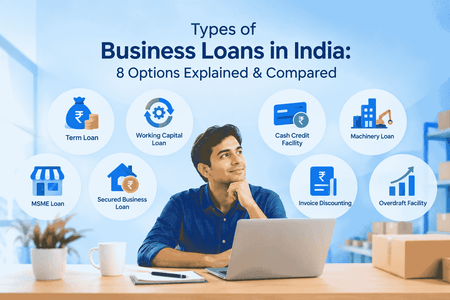
The main types of business loans in India are term loans, working capital loans, overdraft/cash credit, merchant cash advances, equipment loans, women entrepreneur loans, government schemes, and startup loans. Each suits a different need: term loans fund one-time investments, while working capital products cover day-to-day cash gaps.
What is a Business Loan?
A business loan is a formal debt financing agreement where a business receives funds to manage operations, purchase assets, or fuel expansion, committing to repay the principal with interest over a predetermined tenure. These financial instruments provide enterprise owners with structured capital without requiring equity dilution.
In the commercial lending landscape, business loan types are broadly categorised through two distinct frameworks:
- By Purpose and Disbursement Structure: Grouped into structured lump-sum disbursements for capital expenditures (term loans), revolving operational facilities (overdrafts), or asset-backed instruments (equipment financing).
- By Security/Collateral Requirements: Divided into secured loans (requiring collateral like real estate or fixed deposits) and unsecured business loans (approved based on cash flows, credit scores, and financial history).
Selecting the correct facility structure is critical to financial stability. Opting for a 3-year term loan to address a temporary 60-day cash gap forces your enterprise to pay interest on money long after the operational need has passed. Aligning tenure and structure to cash flow needs keeps interest costs manageable. Explore tailored business loan options to scale your business seamlessly.
8 Types of Business Loans in India
Choosing the correct financing facility requires understanding the mechanics, costs, and strategic advantages of each option available to Indian MSMEs.
1. Term Loan
A term loan is a financial facility where a borrower receives a single lump-sum payout and repays it over a fixed tenure through Equated Monthly Installments (EMIs). These loans are structured as short-term (up to 3 years) or long-term (up to 10+ years). They are best used for capital expenditure, office expansion, or large-scale inventory purchases. Indifi offers collateral-free term loans up to ₹50 lakh with flexible tenures up to 48 months, interest rates starting from as little as 1.5% per month, and zero asset pledging. Learn more on our term loan page.
2. Working Capital Loan
A working capital loan is a short-term financing facility designed to cover day-to-day operational expenses like supplier payments, staff salaries, rent, and inventory upkeep. It bridges the cash gap between money going out and customer receivables coming in, ensuring uninterrupted liquidity. These loans typically run on flexible 3- to 12-month tenure horizons with monthly or daily repayment cycles. For instance, a manufacturing unit can use this loan to buy raw materials upfront during seasonal demand peaks. Check our working capital loan page.
3. Overdraft & Cash Credit
An overdraft and cash credit facility provides bank-account-linked revolving credit limits that allow businesses to withdraw funds beyond their zero balance. Overdraft (OD) facilities are generally linked to current accounts or fixed deposits, whereas Cash Credit (CC) accounts are sanctioned against primary security such as physical stock and accounts receivable. Best suited for continuous short-term cash needs, interest is charged daily on the utilised balance.
4. Equipment / Machinery Loan
An equipment loan is an asset-specific credit facility built to fund the purchase of commercial machinery, tools, or industrial apparatus required for operations. In most cases, the purchased machinery serves as the primary hypothecated collateral for the loan, reducing personal asset exposure. For example, a garment manufacturing enterprise can acquire specialised high-speed automated stitching units while spreading out the asset cost over a 3 to 5-year repayment schedule.
5. Business Loans for Women Entrepreneurs
Securing business capital has traditionally been difficult for women, primarily because property and traditional collateral assets are often registered under male family members. A business loan for women entrepreneurs is a dedicated financial product engineered to overcome these exact barriers through preferential interest rates, lowered processing fees, and relaxed collateral constraints. At Indifi, we actively support women entrepreneurship by removing this friction and making the process entirely about the enterprise; your business performance is all Indifi cares about, rather than traditional asset ownership. Best used by female business owners scaling their operations, these loans often integrate with government guarantees to expand capital access. Discover tailored terms on our women business loan page.
6. Government-Backed MSME Loans
A government-backed MSME loan is a subsidised or credit-guaranteed financing instrument extended under official national schemes to improve institutional credit delivery to micro and small businesses. Key schemes include PM Mudra Yojana (providing collateral-free loans up to ₹10 lakh across Shishu, Kishor, and Tarun categories), CGTMSE (offering credit guarantee coverage up to ₹5 crore for collateral-free bank loans), Stand-Up India (funding SC/ST and women entrepreneurs between ₹10 lakh and ₹1 crore), and PMEGP (assisting setup of micro-enterprises with credit-linked subsidies up to ₹50 lakh). Explore options in our guide to MSME loan schemes.
7. Startup / New Business Loans
A startup business loan is specialised seed or early-stage capital targeting young enterprises with limited operating vintage (under 2 years). Because standard financial auditing criteria may be difficult to meet initially, eligibility focuses heavily on promoter credit profiles, initial cash projections, and business model viability. These loans help cover setup infrastructure, product development, and initial marketing campaigns. Check eligibility options in our guide on collateral-free business loans for startups.
8. Indifi Pay / B2B Working Capital Solutions
Indifi Pay is a specialised digital credit line targeting micro, small, and medium enterprises (MSMEs) with limited operating vintage that need flexible liquidity for regular business transactions. Because standard financial auditing or long-term credit history may be difficult to establish initially, eligibility evaluates promoter profiles, operational cash flows, and supply chain trade patterns. These credit lines help cover recurring vendor payments, bulk inventory procurement, and short-term working capital gaps. Check options and features on the Indifi Pay.
Secured vs Unsecured Business Loans
Understanding the distinction between secured and unsecured structures is essential before submitting a loan application.
Secured business loans require the borrower to pledge physical assets, such as residential/commercial real estate, machinery, gold, or bank fixed deposits, as security against loan default. Because collateral lowers lender risk, secured loans usually feature larger sanction limits, lower interest rates, and longer repayment terms. Conversely, unsecured business loans (collateral-free loans) require zero asset pledging. Lenders evaluate financial health, banking cash flows, GST compliance, and credit bureau scores to issue approvals.
| Aspect | Secured Loans | Unsecured Loans |
| Collateral Needed | Mandatory (Property, FD, Machinery, Stock) | None (Zero asset pledging) |
| Typical Loan Size | High (Up to ₹10+ Crore) | Moderate to High (Up to ₹1 Crore) |
| Interest Rate | Lower (Lower risk profile) | Slightly higher (Risk based on cash flow) |
| Processing Time | Slower (15–30 days for legal asset valuation) | Fast (24 to 48 hours digital approval) |
| Risk to Borrower | High (Risk of collateral forfeiture) | Low (No direct personal asset risk) |
| Best For | Long-term capital expenditure, heavy factory setup | Urgent liquidity, working capital, quick expansion |
Most modern fintech platforms, including Indifi, specialise in secured and unsecured funding structures. This allows businesses to access growth capital quickly without risking core property assets.
Types of Business Loans Compared
Compare the key features across all 8 business loan categories at a glance:
| Loan Type | Best For | Typical Tenure | Repayment Style | Collateral |
| Term Loan | Asset purchase, expansion | 48 months | Fixed monthly EMIs | Nil (Fintech) / Pledged (Banks) |
| Working Capital Loan | Day-to-day operational costs | 3 to 12 months | Monthly / Bullet payment | None required |
| Overdraft & Cash Credit | Continuous bank liquidity | Annual renewal | Daily interest calculation | FD, Property, or Stock |
| Equipment Loan | Machinery purchases | 3 to 5 years | Fixed monthly EMIs | Hypothecated machinery |
| Women Entrepreneur Loan | Female-led business scaling | 12 to 36 months | Fixed monthly EMIs | Nil under MSME guarantee |
| Government MSME Schemes | Micro-enterprise setup | 3 to 7 years | Structured monthly EMIs | Nil up to scheme caps |
| Startup Loan | Early-stage enterprise launching | 12 to 36 months | Flexible monthly EMIs | None required |
| Indifi Pay | B2B vendor payments & short-term liquidity | Up to 60 days | Flexible digital repayment | Digital credit line |
Which Business Loan Is Right for Your Need?
Selecting the right borrowing facility depends on your specific operational requirement. The table below matches common business challenges with their optimal loan type:
| Business Need | Best-Fit Loan Type | Why It Fits Best |
| Purchasing modern heavy machinery | Term / Equipment Loan | Spreads major capital expenditure costs across long-term fixed EMIs. |
| Seasonal inventory stock-up | Working Capital Loan | Provides quick short-term cash to build inventory before sales spikes hit. |
| High POS card transaction retail outlet | Merchant Cash Advance | Matches repayment directly to real-time daily card sales receipts. |
| First-time founder launching a venture | Startup / Mudra Loan | Offers subsidised credit lines backed by government guarantee schemes. |
| Opening a second physical retail location | Term Loan | Delivers large capital amounts required for leasing, interiors, and initial setup. |
Matching your specific financial bottleneck with the right instrument prevents excess interest expenses and operational stress. To bridge immediate liquidity gaps, explore dedicated working capital loan options tailored for MSMEs.
How to Choose the Right Type of Business Loan
Evaluate these six core parameters before signing any commercial credit agreement:
- Match Loan Tenure to Purpose: Never fund long-term capital investments using short-term operational lines, or vice versa. Keep short-term gaps tied to short repayment cycles.
- Evaluate Total Borrowing Cost: Compare overall annual percentage rates (APR), including processing fees, administrative costs, and documentation charges, rather than focusing only on the nominal interest rate.
- Align Repayment Schedules with Cash Flow: Ensure repayment frequency matches your revenue cycle, whether structured as monthly EMIs, daily card deductions, or single lump-sum invoice clearances.
- Check Collateral Exposure: Decide whether you are willing to pledge real estate or fixed deposits, or if an unsecured cash-flow loan better protects your asset independence.
- Prioritise Disbursal Speed: If addressing urgent supplier dues, speed matters. Digital platforms disburse within 48 hours, whereas traditional bank collateral procedures can take several weeks.
- Review Minimum Eligibility Criteria: Confirm your business meets baseline operational vintage, minimum turnover thresholds, and credit score guidelines before applying.
To calculate potential monthly repayments across structured options, use our free online business loan EMI calculator.
Business Loan Eligibility & Documents (Common to Most Types)
While specific credit checks vary between loan products, digital MSME financing typically requires meeting these core eligibility guidelines:
- Business Vintage: Minimum 1 year of continuous business operations.
- Annual Turnover: Minimum gross sales turnover of ₹12 lakh over the trailing 12 months.
- Credit Bureau Score: CIBIL with 650 can check their eligibility.
- Applicant Age: Between 22 and 60 years old at the time of application.
- Tax Compliance: Regular GST filing history over the previous 12 months.
Required Documentation:
- Identity & Address Proof: PAN Card and Aadhaar Card of the business applicant/promoters.
- Business Registration Proof: GST Registration Certificate, Shop & Establishment License, or Udyam Aadhaar.
- Financial Statements: 6 to 12 months of updated operational bank account statements.
- Tax Documentation: Recent GST returns (Form GSTR-3B) and Income Tax Returns (ITR), where applicable.
For detailed, product-specific breakdowns, review our comprehensive overview on business loan eligibility.
Business Loans from Indifi: Which Products Are Available?
Indifi provides digital, collateral-free credit solutions built specifically to serve the growth needs of Indian micro, small, and medium enterprises (MSMEs).
| Product Name | Key Highlight | Direct Application |
| Term Loan | Up to ₹50 lakh funding; flexible tenure up to 36 months | Apply for Term Loan |
| Working Capital Loan | Fast operational liquidity; disbursed within 48 hours | Apply for WC Loan |
| Merchant Cash Advance | Funding up to ₹1 crore; auto-repaid via daily POS card sales | Apply for MCA |
| Women Business Loan | Tailored growth capital with preferred terms for female founders | Apply for Women Business Loan |
All Indifi financial facilities operate on a 100% online, paperless application flow with zero collateral requirements, enabling quick disbursals in as little as 48 hours for verified applicants.
Conclusion
There is no single “best” business loan; success lies in matching the right credit facility to your specific business need, repayment capability, and operational timeline. Whether you are bridging a temporary cash gap with a working capital loan or purchasing machinery via a structured term loan, choosing the correct instrument protects your liquidity. Evaluate your requirements carefully and apply online through Indifi’s business loan portal to secure collateral-free funding for your enterprise today.
Frequently Asked Questions
What are the main types of business loans in India?
The main types of business loans in India include term loans, working capital loans, overdrafts, cash credit, merchant cash advances, equipment financing, women entrepreneur loans, and government MSME schemes. Each serves specific operational or expansion requirements.
Which type of business loan is best for a small business?
An unsecured working capital loan is generally best for small businesses needing quick liquidity without pledging assets. These options cover day-to-day operational cash gaps without requiring long-term interest commitments.
What is the difference between a term loan and a working capital loan?
A term loan delivers a single lump-sum payout repaid via fixed EMIs over a set tenure, ideal for capital expenditures. A working capital loan addresses immediate operational costs like payroll or inventory, running over shorter repayment horizons.
What is the difference between secured and unsecured business loans?
Secured business loans require pledging assets like real estate or fixed deposits, offering higher funding limits at lower interest rates. Unsecured loans require no collateral, evaluating credit history and banking cash flows for fast approval.
Can I get a business loan without collateral?
Yes, MSMEs can secure collateral-free business loans up to ₹50 lakh through digital lenders like Indifi. Eligibility is evaluated using operational cash flows, annual turnover, GST filings, and credit scores rather than physical collateral.
Which business loan is easiest to get for a new business?
Government schemes like PM Mudra Yojana or CGTMSE-backed credit lines are generally easiest for new enterprises. Alternatively, digital merchant cash advances based on card swipe sales offer accessible entry routes for new retail businesses.
What types of business loans does Indifi offer?
Indifi offers collateral-free term loans, flexible working capital loans, merchant cash advances against card sales, and customised business loans for women entrepreneurs.