

Key Takeaways
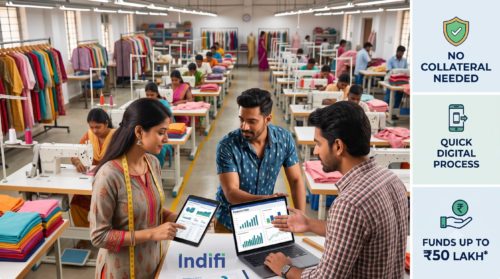
- Garment manufacturers can access collateral-free working capital loans up to ₹50 lakh through NBFCs and digital lenders.
- The 90 to 120-day payment cycle in garment manufacturing creates predictable cash crunches that working capital loans can bridge.
- Invoice discounting helps export-focused garment units unlock cash from unpaid B2B orders without waiting for buyer payments.
- Government schemes like MUDRA and CGTMSE offer low-cost options, while NBFC loans provide faster disbursal for urgent needs.
Garment manufacturers in India can obtain collateral-free working capital loans of up to ₹50 lakh from digital lenders and NBFCs, typically disbursed within 48 hours. Basic eligibility includes 1+ years of business vintage, ₹12 lakh+ in annual turnover, and regular GST filings. No property pledge required.
Why Garment Manufacturers Face a Working Capital Crunch
India’s textile and apparel industry is one of the country’s largest employment generators, supplying everything from everyday clothing to premium fashion and export garments. However, behind every finished product lies a business that must carefully manage cash flow. Garment manufacturers often spend significant amounts on raw materials, labour, electricity, packaging, and transportation long before they receive payment from buyers. While production continues daily, customer payments, especially from wholesalers, retailers, and export clients, can take anywhere from 90 to 120 days to arrive. This gap creates a working capital crunch that affects day-to-day operations, which is why a dedicated garment loan is often the fastest way to stay ahead of the cycle.
Traditional banks often under-serve small garment units precisely when this crunch hits hardest. Most banks require property or fixed-asset collateral before extending working capital credit, a hurdle that rules out many proprietorships and job-work units that don’t own land or factory premises outright. Even when a unit does qualify, bank processing can take two to four weeks: project reports, collateral valuation, and multiple rounds of documentation stand between an approved order and available cash. For a manufacturer who needs to buy fabric within days of confirming a bulk order, that timeline simply doesn’t work.
A working capital loan helps bridge this gap by providing quick access to funds without requiring business owners to pledge property or other assets as collateral. Instead of delaying production or turning away large orders due to cash shortages, manufacturers can continue operating smoothly while waiting for customer payments. If you’re looking for a business loan for a textile business specifically, this guide explains how to get a garment loan or textile loan without collateral, who is eligible, the documents required, available financing options, and how to apply online.
What is a Working Capital Loan for a Garment Business?
A working capital loan is short-term financing that covers day-to-day operational expenses. For garment manufacturers, it bridges the gap between production spending and buyer payments. Unlike long-term financing, working capital loans are designed for recurring operational needs rather than one-time investments.
Working capital vs term loan vs line of credit
Different financing needs call for different products. Here is how they compare for garment business requirements:
| Financing Need | Right Product | Why |
|---|---|---|
| Fabric stocking before the festive season | Working capital loan | Fixed amount, defined repayment, matches the seasonal cycle |
| New stitching machines or embroidery units | Term loan | Long-term asset, longer tenure, structured EMIs |
| Ongoing raw material purchases | Line of credit | Draw as needed, pay interest only on the used amount |
The key distinction is that working capital loans address your operating cycle, while term loans fund capital expenditures, and lines of credit provide flexible access to funds as needed. Many garment manufacturers need all three at different times.
Financing Options for Garment & Textile Manufacturers
Collateral-free NBFC working capital loans
A garment loan from an NBFC or digital lending platform gives small manufacturers unsecured working capital without the wait banks require. These loans require no property pledge. Instead, lenders assess your business through bank statements, GST returns, and transaction history. Loan amounts are typically offered up to ₹50 lakh. Disbursal can happen within 48 hours of approval. For a garment unit that just received a large order and needs fabric immediately, this speed matters more than marginally lower bank rates that come with month-long processing.
Line of credit for seasonal inventory
A business line of credit works like a pre-approved limit you can draw from as needed. During peak seasons, you draw more. During lean months, you draw less or nothing. You pay interest only on the amount actually used. For garment manufacturers with predictable seasonal swings, this flexibility reduces borrowing costs compared to taking a lump-sum loan and paying interest on the full amount year-round.
Government schemes: MUDRA, CGTMSE, TUFS, and PLI
Several government programmes support garment and textile manufacturers:
- MUDRA Loans: The Pradhan Mantri MUDRA Yojana offers loans in three categories: Shishu (up to ₹50,000), Kishore (₹50,001 to ₹ 5 lakh), and Tarun (₹5 lakh to ₹20 lakh). The Tarun limit was increased from ₹10 lakh to ₹20 lakh. These loans come at lower interest rates but involve longer processing times.
- CGTMSE: The Credit Guarantee Fund Trust for Micro and Small Enterprises provides collateral-free credit guarantees, enabling banks to lend to MSMEs without property security.
- ATUFS: The Amended Technology Upgradation Fund Scheme offers capital subsidies for textile machinery upgrades.
- PLI for Textiles: The Production Linked Incentive scheme supports manufacturers in man-made fibre and technical textiles, though it targets larger investments.
Government schemes offer cost advantages but require patience. NBFC loans complement these by providing speed when you cannot wait for bank processing.
Eligibility Criteria
Most NBFC lenders apply similar eligibility standards for garment manufacturers:
| Criteria | Requirement |
|---|---|
| Applicant Age | 22–60 years |
| Business Vintage | Minimum 1 year |
| Annual Turnover | ₹12 lakh or above |
| GST Registration | Active GST with at least 12 months of filing history |
| Income Tax Returns | Last 2 years |
| Credit Score | 650+ preferred (flexible depending on lender) |
Eligible business entities
Garment manufacturing in India operates across multiple business structures. Most small units run as proprietorships, which are fully eligible for working capital loans.
Partnerships, LLPs, and Private Limited companies also qualify.
If you run a job-work unit (processing fabric for other manufacturers rather than selling finished garments), you can still qualify. Lenders look at your transaction history and payment regularity, not just whether you sell directly to end buyers.
Registration on the Udyam portal strengthens your application and is required for accessing government schemes.
Documents Required
One of the biggest advantages of applying through digital lenders is the simplified documentation process. A typical checklist:
- PAN card (business and promoter)
- Aadhaar card of the promoter
- 6 months of business bank statements
- GST returns for 12 months
- ITR for 2 years
- Udyam registration certificate
The core difference from bank lending is that NBFC underwriting relies on data, including your actual transaction patterns, GST compliance, and banking behaviour. Banks often require detailed project reports, collateral valuation papers, and longer documentation trails that small garment units struggle to produce.
Interest Rates & Charges
Working capital loans from NBFCs carry higher rates than secured bank loans but compensate with speed and accessibility.
| Charge Type | Typical Range |
|---|---|
| Interest rate | 1.5%–2% per month (18%–24% per annum) |
| Processing fee | Up to 4% of the loan amount |
| Prepayment charges | Usually nil after the lock-in period |
Rates vary based on your credit profile, business vintage, and the specific lending partner. Through platforms like Indifi, your application is matched with multiple lending partners, and you receive offers based on your profile.
Worked EMI example
Consider a ₹10 lakh working capital loan for pre-festive fabric stocking:
- Loan amount: ₹10 lakh
- Tenure: 24 months
- Interest rate: 18% per annum (1.5% per month)
- Approximate EMI: ₹49,924 per month
If your festive order generates ₹15 lakh in revenue with a 20% margin, the ₹3 lakh profit comfortably covers the borrowing cost. The loan enabled revenue you could not have captured otherwise.
How to Apply Online — 6 Steps, 10 Minutes
Most digital lenders have streamlined the application process, allowing eligible businesses to complete it online in around 10 minutes.
Step 1: Verify Your Mobile Number
Enter your mobile number and complete OTP verification to begin the application.
Step 2: Share Business Details
Provide information such as business name, industry, annual turnover, GST number, and years in operation.
Step 3: Upload Required Documents
Submit digital copies of PAN, Aadhaar, GST returns, bank statements, and ITRs.
Step 4: Receive Loan Offers
Based on your business profile and financial data, eligible loan offers are displayed for review.
Step 5: Complete e-Sign Verification
Digitally accept the selected loan offer and complete the agreement using e-sign.
Step 6: Loan Disbursal
Once verification is complete, approved funds are transferred directly to the business bank account, often within 48 hours.
Cluster Spotlight: Where India’s Garment Money Moves
Tirupur: Knitwear export capital
Tirupur’s knitwear industry reached a record ₹ 40,000 crore in exports in FY25. Manufacturers here work on export order cycles with 60- to 90-day payment terms from international buyers. Invoice discounting has become a critical financing tool for these units, converting receivables into working capital without waiting for overseas payments. With buyer payment cycles stretching to 90 days on large export orders, manufacturers who rely solely on bank credit often lose ground to competitors using faster invoice-based financing.
Surat: Synthetic fabric and job-work hub
Surat’s powerloom and synthetic fabric industries operate on razor-thin margins and at high volumes. Job-work units here process fabric for manufacturers across India. Working capital needs centre on managing thread and dye inventory while awaiting payments from principal manufacturers. The speed of financing often matters more than differences in interest rates. With multiple job-work orders running in parallel, a delay in one payment can stall production across several accounts at once, making quick-disbursal working capital loans especially valuable here.
Delhi NCR and Ludhiana: Readymade garments and winterwear
The Delhi-NCR region houses a dense network of ready-made garment manufacturers supplying the domestic retail and e-commerce sectors. Ludhiana specialises in hosiery and winterwear with sharp seasonal peaks. Both clusters face a similar challenge: financing the October-to-February production surge when demand is concentrated in a four-month window while costs are spread across the year.
5 Smart Ways Garment Manufacturers Use Working Capital
- Pre-festive fabric stocking: Buying fabric two to three months before Diwali or the wedding season locks in better rates and ensures supply. Working capital loans fund this early purchase.
- Bulk-order raw material: When a large buyer places an order, you need to purchase fabric, trims, and accessories immediately. Waiting for internal cash flow means missing the order.
- Wage bridging during production peaks: Adding extra shifts or temporary workers during busy periods requires cash before customer payments arrive.
- Adding stitching capacity: Financing additional stitching lines or embroidery units to handle larger orders. While the machinery itself may require a term loan, the associated working capital (more fabric, more wages) requires separate funding.
- Digital and D2C expansion: Launching your own e-commerce presence or supplying online marketplaces requires an upfront investment in inventory. Working capital loans support this transition from purely B2B models.
Taking the next step
Whether you call it a garment loan or a textile loan, the industry’s cash cycle creates predictable financing needs. Collateral-free working capital loans from NBFCs fill this gap, especially for proprietorships and small units without property to pledge as collateral. Your choice depends on urgency, loan size, and cost tolerance. Government schemes cost less but take longer. NBFC loans typically cost more but are often disbursed within days, while also offering flexible repayment options and loan tenures. Many manufacturers use both government schemes for planned investments and NBFC loans for urgent order financing.
FAQs
1. Can I get a garment business loan without collateral?
Yes. NBFCs and digital lending platforms offer collateral-free working capital loans for garment manufacturers. Eligibility depends on your business vintage, turnover, GST filing history, and credit score rather than property ownership.
2. What is the interest rate on a textile loan or textile business loan?
Interest rates start at 1.5% per month (18% per annum) for NBFC loans. Actual rates depend on your credit profile, business strength, and the specific lending partner. Government schemes like MUDRA may offer lower rates but involve longer processing.
3. Can a job-work unit qualify for a working capital loan?
Yes. Job-work units that process fabric for other manufacturers can qualify. Lenders assess your bank transaction history, payment regularity from principals, and GST compliance rather than requiring direct retail or export sales.
4. What is the minimum turnover required?
Most NBFC lenders require an annual turnover of ₹12 lakh or above. Some platforms may consider businesses with lower turnover if other parameters, such as credit score and banking history, are strong.
5. How fast is the disbursal?
Digital lending platforms can disburse funds within up to 48 hours of approval. This compares to two to four weeks for traditional bank loans. Speed depends on the completeness of the document and its verification.
6. Can exporters apply for these loans?
Yes. Export-focused garment manufacturers can apply. Invoice discounting is particularly useful for exporters with unpaid international receivables. Standard working capital loans also help fund production before export orders ship.
7. Should I choose MUDRA or an NBFC loan for my small garment unit?
MUDRA loans offer lower interest rates and government backing, with limits of up to ₹ 20 lakh under the Tarun Plus category. However, processing takes longer. NBFC loans cost more but disburse faster. If you have time, apply for MUDRA. If you need funds within days for an urgent order, an NBFC loan makes more sense.
Disclaimer: The information provided here is for general informational purposes and may be subject to change. Loan terms, eligibility, and interest rates are determined by Indifi’s lending partners and may vary based on individual assessment. Please visit indifi.com for the most current information.