

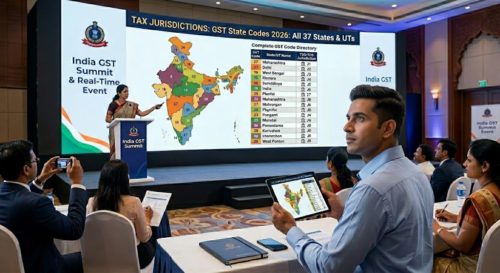
Key Takeaways
- Every GSTIN in India begins with a two-digit GST state code that identifies the taxpayer’s registered state or UT.
- As of FY 2025–26, there are 37 active GST state codes from 01 (Jammu and Kashmir) to 38 (Ladakh).
- Following the J&K bifurcation in October 2019, Ladakh was assigned code 38 while J&K retained code 01.
- Daman and Diu (code 25) was merged with Dadra and Nagar Haveli under code 26 in January 2020.
- Using an incorrect state code on an invoice can lead to ITC mismatches and errors in return filing.
What is GSTIN?
GSTIN stands for Goods and Services Tax Identification Number. It is a unique 15-digit alphanumeric identifier assigned to every taxpayer registered under India’s GST system, as per the CGST Act, 2017. The first two digits of a GSTIN represent the GST state code of the state or UT where the business is registered.
Example: A GSTIN beginning with 27 belongs to a Maharashtra-registered entity. A GSTIN beginning with 07 belongs to Delhi.
Also Read: New GST Rates In 2022
Complete GST State Code List 2026: All 37 States and UTs
The table below lists all active GST state codes for FY 2025–26. Data sourced from the Central Board of Indirect Taxes and Customs (CBIC) and verified against gst.gov.in.
| GST State Code | State / Union Territory | GST Zone / Jurisdiction |
|---|---|---|
| 01 | Jammu and Kashmir (UT with legislature) | North Zone |
| 02 | Himachal Pradesh | North Zone |
| 03 | Punjab | North Zone |
| 04 | Chandigarh (UT) | North Zone |
| 05 | Uttarakhand | North Zone |
| 06 | Haryana | North Zone |
| 07 | Delhi (UT) | North Zone |
| 08 | Rajasthan | North Zone |
| 09 | Uttar Pradesh | North Zone |
| 10 | Bihar | East Zone |
| 11 | Sikkim | East Zone |
| 12 | Arunachal Pradesh | North East Zone |
| 13 | Nagaland | North East Zone |
| 14 | Manipur | North East Zone |
| 15 | Mizoram | North East Zone |
| 16 | Tripura | North East Zone |
| 17 | Meghalaya | North East Zone |
| 18 | Assam | North East Zone |
| 19 | West Bengal | East Zone |
| 20 | Jharkhand | East Zone |
| 21 | Odisha | East Zone |
| 22 | Chhattisgarh | Central Zone |
| 23 | Madhya Pradesh | Central Zone |
| 24 | Gujarat | West Zone |
| 25 | Daman and Diu (discontinued — merged into code 26, Jan 2020) | West Zone |
| 26 | Dadra and Nagar Haveli and Daman and Diu (UT — merged Jan 2020) | West Zone |
| 27 | Maharashtra | West Zone |
| 28 | Andhra Pradesh (undivided — legacy code, pre-2014) | South Zone |
| 29 | Karnataka | South Zone |
| 30 | Goa | West Zone |
| 31 | Lakshadweep (UT) | South Zone |
| 32 | Kerala | South Zone |
| 33 | Tamil Nadu | South Zone |
| 34 | Puducherry (UT) | South Zone |
| 35 | Andaman and Nicobar Islands (UT) | South Zone |
| 36 | Telangana | South Zone |
| 37 | Andhra Pradesh (residual — post-2014 bifurcation) | South Zone |
| 38 | Ladakh (UT without legislature — added Oct 2019) | North Zone |
| 97 | Other Territory | — |
| 99 | Centre Jurisdiction | — |
Notes on key code changes:
- Code 01 — Jammu and Kashmir: Retains code 01 as a UT with legislature following the J&K Reorganisation Act, 2019.
- Code 38 — Ladakh: Assigned as a new UT (without legislature) upon bifurcation from J&K on 31 October 2019.
- Code 25 — Daman and Diu: Discontinued after the administrative merger with Dadra and Nagar Haveli in January 2020. Existing legacy GSTINs under code 25 remain valid.
- Code 26 — Dadra and Nagar Haveli and Daman and Diu: Active code for the merged UT.
- Code 28 — Andhra Pradesh (undivided): A legacy code from before the 2014 bifurcation. New registrations use code 37.
- Code 37 — Andhra Pradesh (residual): The current active code for Andhra Pradesh post-bifurcation.
- Code 97 — Other Territory: Used for supplies to locations outside India but within customs territory, and for UN bodies.
- Code 99 — Centre Jurisdiction: Used for foreign service providers registered under OIDAR and similar central-jurisdiction cases.
Understanding GST State Codes
Let’s start by setting the context. The Goods and Services Tax Identification Number (GSTIN) is a unique identifier consisting of 15 characters. It’s assigned to every taxpayer registered under India’s Goods and Services Tax (GST) system. This identifier includes a state code, PAN-based taxpayer identification, business entity details, and a verification digit.
The first two digits of the GSTIN represent the GST State Code. This code is crucial for various transactions and filings, ensuring a standardized and transparent tax administration system. Each state and Union Territory in India has its own unique code, which helps quickly identify the taxpayer’s geographical location. For example, the GST state code 32 is assigned to Kerala, while Delhi’s state code is 07.
Also Read:- How To Check A Fake GST Bill/Invoice?
The GST state code list comes with alphabetical codes, as mentioned below.
| STATE NAME | STATE CODE | Alpha Code |
| JAMMU AND KASHMIR | 1 | JK |
| HIMACHAL PRADESH | 2 | HP |
| PUNJAB | 3 | PB |
| CHANDIGARH | 4 | CH |
| UTTARAKHAND | 5 | UA |
| HARYANA | 6 | HR |
| DELHI | 7 | DL |
| RAJASTHAN | 8 | RJ |
| UTTAR PRADESH | 9 | UP |
| BIHAR | 10 | BR |
| SIKKIM | 11 | SK |
| ARUNACHAL PRADESH | 12 | AP |
| NAGALAND | 13 | NL |
| MANIPUR | 14 | MN |
| STATE NAME | STATE CODE |
| MIZORAM | 15 |
| TRIPURA | 16 |
| MEGHALAYA | 17 |
| ASSAM | 18 |
| WEST BENGAL | 19 |
| JHARKHAND | 20 |
| ODISHA | 21 |
| CHATTISGARH | 22 |
| MADHYA PRADESH | 23 |
| GUJARAT | 24 |
| DADRA AND NAGAR HAVELI AND DAMAN AND DIU | 26 |
| MAHARASHTRA | 27 |
| ANDHRA PRADESH (BEFORE DIVISION) | 28 |
| KARNATAKA | 29 |
| GOA | 30 |
| LAKSHADWEEP | 31 |
| KERALA | 32 |
| TAMIL NADU | 33 |
| PUDUCHERRY | 34 |
| ANDAMAN AND NICOBAR ISLANDS | 35 |
| TELANGANA | 36 |
| ANDHRA PRADESH (NEWLY ADDED) | 37 |
| LADAKH (NEWLY ADDED) | 38 |
| OTHER TERRITORY | 97 |
| CENTRE JURISDICTION | 99 |
Also Read: All About GST, GST Full Form & Meaning, Types Of GST In India – What Is CGST, SGST, And IGST?
Understanding GST State Codes
The GST state code is derived from the Indian Census and was adopted into the GST framework when GST came into effect in July 2017. Each state and UT received a unique two-digit code. The first two digits of any GSTIN instantly tell you which state or UT that business is registered in.
How the State Code Determines the Type of GST Charged
The GST state code plays a direct role in deciding whether CGST + SGST or IGST applies to a transaction:
Different state codes for buyer and supplier: Inter-state supply — IGST applies.
Same state code for buyer and supplier: Intra-state supply — CGST and SGST (or UTGST for UTs without legislature) apply.
Objective of GST State Code
- Determining the correct GST component (IGST, SGST, or CGST) to be levied on each transaction.
- Identifying the ‘place of supply’ for every GST invoice, which is embedded in the buyer’s GSTIN.
- Enabling separate GST registration for businesses with operations across multiple states.
- Supporting accurate GSTR-1 and GSTR-3B return filings, particularly for B2B transactions.
- Facilitating ITC (Input Tax Credit) reconciliation through GSTR-2A and GSTR-2B matching.

What Is GST jurisdiction?
GST jurisdiction determines which tax authority — Central or State — administers a taxpayer’s GST registration. The Central Board of Indirect Taxes and Customs (CBIC) oversees Central jurisdiction, while each state’s commercial tax department oversees State jurisdiction.
Taxpayers with a turnover below INR 1.5 crore are generally split 90:10 between State and Central jurisdiction through randomised allocation. Taxpayers above INR 1.5 crore are allocated 50:50. To find your specific jurisdiction, use the CBIC portal: cbic-gst.gov.in > Know Your Jurisdiction.
Where State Codes Are Essential in GST
1. GST Registration
When applying for GST registration, the applicant’s state code is embedded into the GSTIN issued by the department. Businesses with branches in multiple states must obtain a separate GSTIN for each state — one GSTIN per state applies.
2. GST Invoices and e-Invoicing
Valid GSTINs of the buyer, seller, and consignee — each carrying their respective state codes — are mandatory fields on every GST invoice and e-invoice. The state codes help the system determine whether IGST or CGST/SGST applies.
3. GSTR-1 and GSTR-3B Return Reporting
B2B invoice details, including GSTINs with embedded state codes, must be reported in GSTR-1 or IFF filings. These are then auto-populated into the buyer’s GSTR-2A and GSTR-2B for ITC reconciliation.
The GST Identification Number (GSTIN) Format
A GSTIN is a 15-digit alphanumeric identifier with the following structure:
- Digits 1–2: GST State Code (e.g., 27 for Maharashtra, 07 for Delhi).
- Digits 3–12: PAN number of the registered taxpayer.
- Digit 13: Entity number — the count of registrations under the same PAN in the same state.
- Digit 14: Defaults to ‘Z’ — reserved for future use by GST authorities.
- Digit 15: Check digit — an alphanumeric character used to validate the GSTIN.

Also Read: GSTIN: What Is GSTIN Number? – Check & Verify GSTIN/UIN Number Online?
How to Find Your GST Jurisdiction
- Visit the CBIC portal at cbic-gst.gov.in.
- Navigate to the ‘Know Your Jurisdiction’ section under the Services tab.
- Select your state from the list on the left.
- Choose your zone, commissionerate, and division from the drop-down menus.
- The system will display your range and jurisdiction details.
Also Read: GST Return – What Is GST Return? Who Should File, Due Dates & Types Of GST Returns?
FAQ
What is the GST state code for Maharashtra?
The GST state code for Maharashtra is 27. Any GSTIN beginning with 27 belongs to an entity registered in Maharashtra. Maharashtra is one of the highest-volume states for GST registrations in India. For reference, a typical Maharashtra GSTIN looks like: 27AAXXX1234A1Z5.
How do I use the GST state code on my invoice?
You do not enter the state code manually on your invoice. The state code is automatically embedded in the GSTIN of both the supplier and buyer. When you enter the GSTINs on your invoice, the GST system reads the first two digits to determine the place of supply and applies the correct tax — CGST + SGST for intra-state, or IGST for inter-state transactions.
What is the GST state code for Delhi?
The GST state code for Delhi is 07. Delhi is a UT with its own state-level GST administration. Any GSTIN starting with 07 — for example, 07AAXXX1234A1Z5 — belongs to a Delhi-registered business. Both CGST and SGST apply to intra-UT transactions in Delhi.
Where can I officially verify GST state codes?
GST state codes are maintained and published by the Central Board of Indirect Taxes and Customs (CBIC). The authoritative source is the official GST portal at gst.gov.in. You can also verify any GSTIN — and its embedded state code — through the ‘Search Taxpayer’ tool on gst.gov.in. For jurisdiction details, use cbic-gst.gov.in.
What is a GST State Code?
A GST state code is a unique two-digit number assigned to every state and UT in India under the GST system. Derived from the 2011 Census framework, it forms the first two digits of every GSTIN and is used across GST registration, invoicing, e-invoicing, and return filing.
What does GST state code 26 represent?
Code 26 represents the merged UT of Dadra and Nagar Haveli and Daman and Diu, following their administrative merger in January 2020. Code 25 (the old Daman and Diu code) was discontinued after the merger, though legacy GSTINs under code 25 remain in the system.
What does GST state code 37 represent?
Code 37 represents the residual Andhra Pradesh state following the 2014 bifurcation that created Telangana (code 36). All new Andhra Pradesh GST registrations use code 37. Code 28 was the old undivided Andhra Pradesh code and is now a legacy identifier.
DISCLAIMER
Indifi Technologies Private Limited produces this content for informational purposes only. It does not constitute financial advice, a loan offer, or a guarantee of loan approval. All loans are subject to the lending partner’s credit assessment, eligibility criteria, and terms and conditions. Interest rates, loan amounts, and tenures are indicative and may vary. Past disbursement timelines are not a guarantee of future processing times. Indifi Technologies Private Limited is a loan origination platform and does not provide loans directly. Lending partners are regulated entities in accordance with applicable RBI guidelines. GST code data is sourced from CBIC/gst.gov.in and is current as of FY 2025–26.