

Key takeaways
- Electrical dealers face unique cash flow pressure from high-value inventory like generators that can sit unsold for months while tying up lakhs in capital
- The PM Surya Ghar rooftop solar scheme creates a working capital gap since dealers must fund equipment and installation before subsidy payments arrive
- Line of credit lets dealers handle seasonal stocking and contractor credit without permanent debt
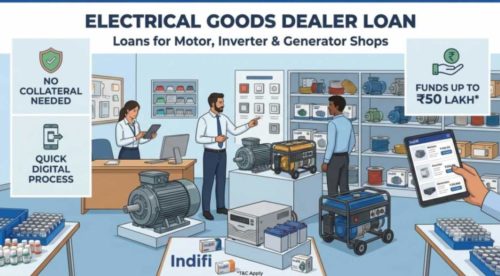
- Collateral-free loans up to ₹50 lakh with disbursal in up to 48 hours can help dealers stock pre-season inventory or fund institutional tenders
Electrical goods dealers can get collateral-free business loans of up to ₹50 lakh to stock high-value items such as generators, motors, and solar equipment and to extend credit to contractors. Eligibility requires 1+ years of business vintage and ₹12 lakh+ in turnover. Disbursal occurs within 48 hours. A single 15 KVA generator sitting in your godown represents ₹3-5 lakh in locked capital. Multiply that across your stock of motors, inverters and stabilisers, and you see why electrical dealers face a distinct cash flow challenge. This guide covers how to finance high-value electrical inventory, manage the working capital demands of solar dealerships, and handle contractor credit without straining your business.
High-Value Stock, Long Shelf Time: The Electrical Dealer’s Capital Problem
Electrical goods dealers operate in a capital-intensive trade where inventory economics work against cash flow. Unlike FMCG retailers who turn stock weekly, you may hold a generator or industrial motor for months before the right buyer appears. Consider the numbers. A single genset in the 10 to 25 KVA range costs ₹2 to ₹10 lakh. Industrial motors, transformer units and high-capacity inverters each represent significant capital. When you stock five or six such items, you have easily locked ₹20 to ₹40 lakh in inventory that earns nothing until sold. The problem compounds with your buyer profile. Builders, factory owners and contractors form your core institutional customer base. These buyers expect 30 to 90-day credit terms as standard practice. So while your supplier demands payment within 15 to 30 days, your receivables stretch for months.
Then comes seasonality. Summer months drive demand for inverters, stabilisers, and UPSes as power cuts increase across India. To capture this demand, you must stock heavily in February and March, well before the sales arrive. India’s electrical equipment sector presents significant growth opportunities, but capturing that growth requires working capital that matches your inventory cycle, not a standard retail loan designed for faster-turning stock.
The Solar Opportunity and Why It Needs Working Capital
Rooftop solar represents the biggest growth opportunity for electrical dealers in this decade. It also creates a distinct working capital challenge that traditional financing does not address well. The PM Surya Ghar Muft Bijli Yojana targets 1 crore households for rooftop solar installation. As of 2026, the scheme has achieved 26 lakh installations, with residential demand driving India’s 3.2 GW rooftop solar capacity added in 2024 alone.
Here is the cash flow problem: customers receive government subsidies only after installation is complete and verified. As a dealer, you must purchase panels, inverters, mounting structures and cables upfront. You fund the installation. Then you wait for the subsidy to be disbursed to the customer, who then pays you.
This cycle can stretch 60 to 120 days from your initial stock purchase to final payment. For a typical 3 kW residential system costing ₹1.5 to 2 lakh, you might have 10 to 15 installations in progress at any given time. That is ₹15-30 lakh locked in working capital just for solar, separate from your regular electrical stock. A solar business loan or dedicated working capital facility lets you fund this cycle without depleting the cash you need for daily operations.
What an Electrical Dealer Loan Can Fund
Business financing for electrical dealers can address multiple capital needs across your operations.
- Pre-summer inverter and battery stocking: An inverter loan or short-term working capital facility lets you stock up on UPS units, inverters and batteries in February–March to capture peak summer demand without draining working capital.
- Generator inventory for institutional tenders: When you spot a hospital, factory or residential complex tender, you need capital to hold adequate generator stock and offer competitive credit terms.
- Solar panel and inverter kits: Fund complete rooftop systems including panels, grid-tie inverters, batteries and mounting hardware while waiting for customer payments.
- Counter and showroom expansion: Upgrade your display area or add dedicated solar demonstration space to attract walk-in customers.
- Contractor credit lines: Extend 30 to 60 days’ credit to electrical contractors and builders without starving your own cash flow.
The key is matching the loan structure to your specific use case. A term loan suits fixed investments like showroom expansion. A line of credit works better for seasonal stocking where you need flexibility to draw and repay as sales come in.
Loan Types That Fit This Trade
Different financing products address different cash flow patterns. Here is how each works for electrical dealers.
Working capital loans
A working capital loan provides a lump sum for day-to-day operational needs. Use it when you need to bridge a consistent gap between supplier payments and customer collections.
Best for: General inventory procurement, managing the cash conversion cycle, covering operating expenses during slow months.
Line of credit for seasonal stocking
A line of credit gives you a pre-approved limit you can draw against as needed. You pay interest only on the amount used.
Best for: Pre-summer inverter stocking, Diwali season preparation, opportunistic bulk purchases when suppliers offer discounts. Draw funds when you stock; repay when you sell.
Term loan for godown or showroom
A term loan provides a fixed amount repaid over a set tenure through EMIs. It suits one-time capital investments rather than recurring working capital needs.
Best for: Opening a new branch, purchasing godown space, major showroom renovation, buying a delivery vehicle.
| Loan type | Best use case | Repayment structure |
|---|---|---|
| Working capital | General inventory, daily operations | Fixed EMI over 12-36 months |
| Line of credit | Seasonal stocking, opportunistic buying | Interest on drawn amount, flexible repayment |
| Term loan | Fixed assets, expansion | Fixed EMI over 12-48 months |
Eligibility and Documents
Eligibility criteria for an electrical shop loan follow standard MSME lending norms, with some flexibility for newer businesses.
| Parameter | Requirement |
|---|---|
| Business vintage | Minimum 1 year of operation |
| Annual turnover | ₹12 lakh or above |
| Business type | Proprietorship, Partnership, LLP, Private Limited |
| Promoter age | 22 years and above |
| CIBIL score | 650+ preferred (varies by lending partner) |
| Collateral | Not required |
Documents typically required:
- GST returns for the last 12 months
- Bank statements for the last 12 months
- PAN card of the business and the proprietor/partners
- Aadhaar card of proprietor/partners
- Business registration proof (Udyam, Shop Act licence, Partnership deed)
- Current business address proof
- Latest ITR with computation (if available)
ITR filing requirements depend on your business’s annual turnover. For businesses that fall below the prescribed turnover threshold, lending partners may assess eligibility using GST returns, bank statements, and overall cash flows instead of relying solely on income tax returns.
Interest Rates and Worked Example
Interest rates for electrical dealer loans start at 1.5% per month (18% per annum). Actual rates depend on your business profile, CIBIL score and the lending partner’s assessment.
| Factor | Impact on rate |
|---|---|
| CIBIL score above 700 | Lower rates |
| Business vintage above 3 years | Lower rates |
| Consistent GST filing | Positive factor |
| Higher turnover | Better terms |
| Clean banking with no bounces | Lower rates |
Worked example: Using an inverter loan for pre-summer stocking
Scenario: You want to stock ₹ 8 lakh worth of inverters and batteries in February to sell during March-June.
- Loan amount: ₹ 8 lakh
- Tenure: 6 months
- Interest rate: 1.5% per month (18% p.a.)
- Processing fee: Up to 4%
Assuming you sell through 70% of stock by May and the remaining 30% by July:
- Total interest cost over 6 months: Approximately ₹43,200
- Processing fee: Up to ₹32,000
- Total financing cost: Approximately ₹75,200
If your margin on inverters is 15%, your gross profit on ₹8 lakh stock is ₹1.2 lakh. After financing costs, you retain roughly ₹44,800 in profit, still a healthy return for capturing demand you’d otherwise miss. You captured summer demand without depleting the working capital needed for other inventory. With a line of credit, your costs could be lower because you pay interest only on amounts drawn and can repay as sales come in, reducing the average outstanding balance.
How to Apply Online
Applying for an electrical dealer business loan through Indifi takes six steps.
Step 1: Select the Right Loan Product
Visit indifi and choose the financing option that best suits your business needs, such as a business loan, working capital loan, or Line of Credit.
Step 2: Complete the Online Application
Fill out the online application form by providing basic business details, including your business name, business type, business vintage, monthly turnover, and the loan amount you require.
Step 3: Upload the Required Documents
Submit digital copies of your GST returns, bank statements, and identity proof through Indifi’s secure online portal to support your application.
Step 4: Get Matched with a Lending Partner
Indifi’s technology evaluates your business profile and connects you with suitable RBI registered NBFCs and banks from its network based on your eligibility.
Step 5: Review and Accept the Loan Offer
Compare loan offers from different lenders, review interest rates and repayment terms, and accept the offer that best meets your business requirements.
Step 6: Receive the Loan Amount
Once your documentation is complete and the selected offer is accepted, the approved loan amount can be disbursed directly to your business bank account in up to 48 hours.
Indifi Technologies has disbursed over 1,60,000 loans across 400+ cities through its network of 80+ lending partners. The platform handles the matching and paperwork; you focus on your business.
Market Spotlight: Delhi, Pune, Ahmedabad
Regional market dynamics affect how electrical dealers approach financing. Here is what matters in three key markets.
Delhi: Bhagirath Palace wholesale hub
Bhagirath Palace in Chandni Chowk is one of Asia’s largest wholesale markets for electrical equipment. Dealers here operate at a massive scale, with some handling monthly turnover in crores. The wholesale nature means thinner margins offset by volume. Competition is intense, and offering better credit terms to buyers becomes a competitive advantage. Working capital loans help Delhi dealers extend buyer credit without compromising their own supplier relationships.
Pune: Industrial belt demand
Pune’s manufacturing corridor creates steady demand for industrial electrical equipment. Factories need motors, control panels, generators for backup power and electrical components for production lines. Industrial buyers mean larger ticket sizes but longer payment cycles. A working capital loan can help electrical dealers bridge this gap by providing funds to manage day-to-day operations, purchase inventory, and meet business expenses while awaiting customer payments.
Ahmedabad: Solar manufacturing proximity
Gujarat hosts significant solar manufacturing infrastructure, contributing to India’s 25.3 GW solar panel manufacturing capacity in 2024. Ahmedabad dealers benefit from proximity to panel manufacturers, reducing logistics costs and enabling faster procurement. This proximity advantage means Ahmedabad dealers can respond quickly to rooftop solar demand, but only if they have working capital ready to stock equipment. Solar business loans let them capitalise on this geographic advantage.
Summing Up
Electrical goods dealing requires capital that moves at a different rhythm than most retail trades. High-value items, institutional credit demands, and seasonal spikes create a cash flow pattern that standard loans often fail to address. The right financing structure, whether a working capital loan for day-to-day operations or a line of credit for seasonal stocking and managing short-term cash flow needs, should match how your business actually works. Explore your options on Indifi to find lending partners who understand the dynamics of the electrical trade.
FAQs
1. Can I get a loan specifically to stock generators?
Yes. A generator loan for dealers is typically structured as a working capital loan or business loan against your stock and turnover, rather than as a separately named product. Apply stating generator inventory as your purpose, and lenders will assess your business fundamentals, GST, banking, and vintage, not the specific brand or stock type you’re financing.
2. Is there financing available for solar dealership businesses?
Solar dealerships can access business loans and working capital loans to fund panel inventory and installation cycles. The PM Surya Ghar scheme creates strong demand, and lenders recognise rooftop solar as a growing segment. Apply through Indifi to connect with partners experienced in solar trade financing.
3. How can I fund credit I extend to contractors?
Lines of credit or working capital loans help you maintain liquidity while extending payment terms to contractors. Either approach lets you offer competitive credit without depleting operating cash.
4. Can a combined hardware and electrical shop qualify?
Yes. If you’re looking for a hardware loan for a shop that also stocks electrical goods, or vice versa, you’re eligible as long as you meet the standard criteria: 1+ year of vintage, ₹12 lakh+ turnover, and proper GST registration. Lenders assess your overall business health, not product category restrictions, so a combined hardware-electrical inventory doesn’t count against you.
5. Do any lenders offer seasonal repayment flexibility?
Some lending partners offer step-up EMI structures or flexible repayment terms for seasonal businesses. A line of credit is inherently flexible since you draw and repay based on your cash flow. Discuss your seasonal pattern during the application process to find partners who accommodate such structures.
Disclaimer: The information provided here is for general informational purposes and may be subject to change. Loan terms, eligibility, and interest rates are determined by Indifi’s lending partners and may vary based on individual assessment. Please visit indifi.com for the most current information.